Miami's real estate market entered the second half of 2026 with stronger sales, fewer available listings and continued price growth across the luxury sector. The most important takeaway, however, is that the market is not moving uniformly. Single-family homes and condominiums are following different timelines, and performance can vary considerably by neighborhood, building, condition and price point.
According to ONE Sotheby's International Realty's Q2 2026 Trends Market Report, sales of Miami-Dade single-family homes priced at $1 million and above increased 26% year over year. Luxury condominium sales rose 12%. At the same time, active inventory contracted in both categories.
The figures point to stronger buyer activity, but not a return to the fast-paced market of several years ago. Buyers remain selective, and the homes attracting the greatest interest are generally those priced and presented correctly from the start.
Miami-Dade Luxury Real Estate at a Glance
The following Q2 figures cover properties priced at $1 million and above:
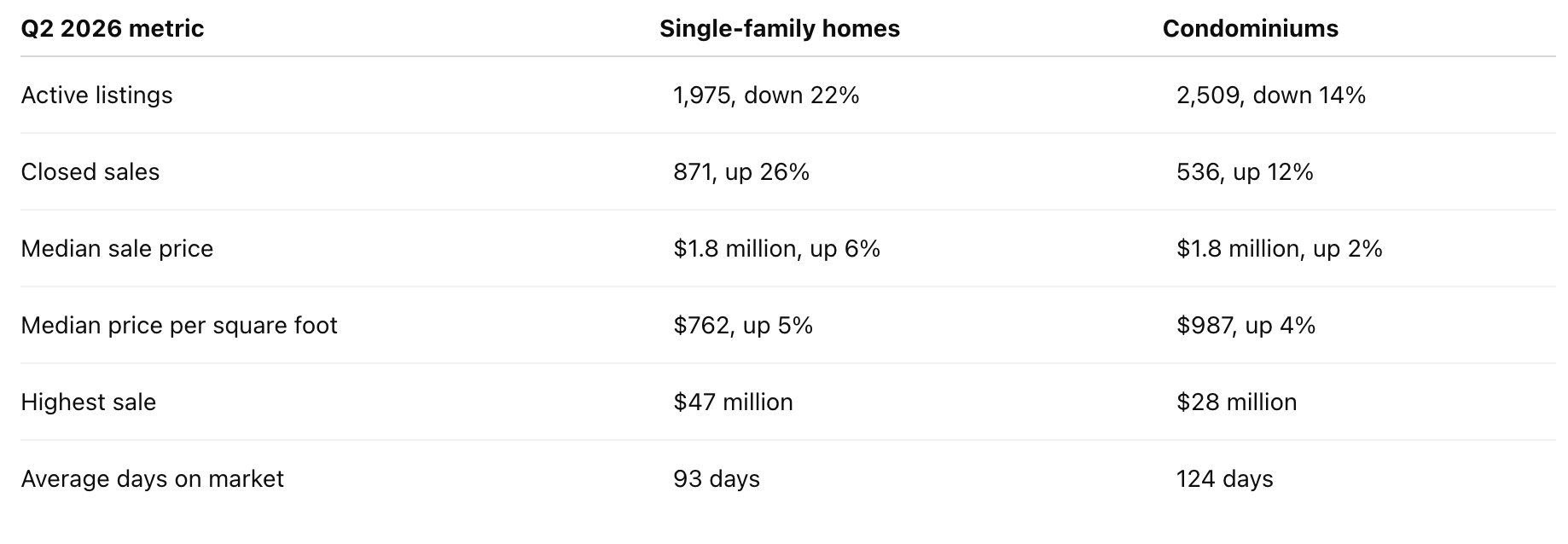
These numbers show a luxury market with improving transaction volume and firmer pricing, but also a meaningful difference in pace. Luxury single-family homes sold more quickly on average, while condos offered buyers a broader selection and more time to evaluate individual opportunities.
Luxury Single-Family Homes Led the Market
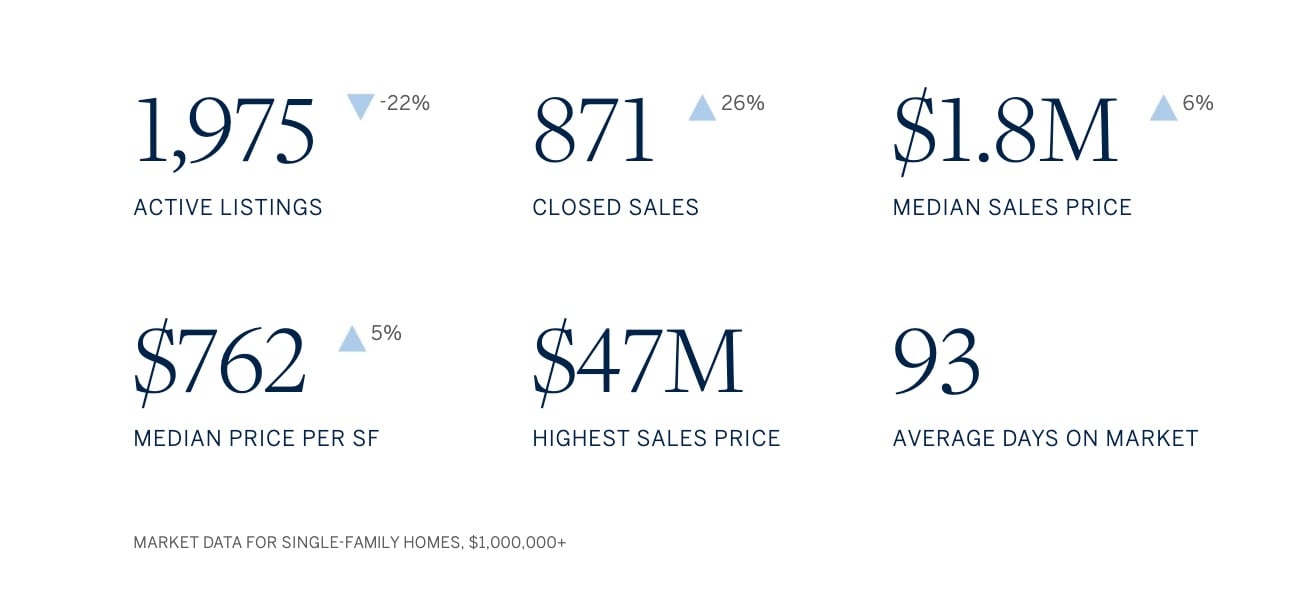
Miami-Dade's luxury single-family segment produced some of the clearest gains of the quarter. Closed sales reached 871, a 26% increase from the prior year, while the median sale price rose 6% to $1.8 million. The median price per square foot increased 5% to $762.
The relationship between new listings and closed sales is especially notable. New luxury single-family listings declined from 504 in April to 395 in June, a drop of approximately 22%. Closings moved in the opposite direction, rising from 265 in April to 306 in June. In other words, more homes were selling at the same time that fewer new options were arriving.
That pattern can support well-prepared sellers, particularly in neighborhoods where renovated or architecturally distinctive homes are difficult to replace. Still, an average market time of 93 days confirms that buyers are not rushing into every listing. Pricing, presentation and condition continue to shape the result.
Miami's Luxury Condo Market Is Active, but More Selective
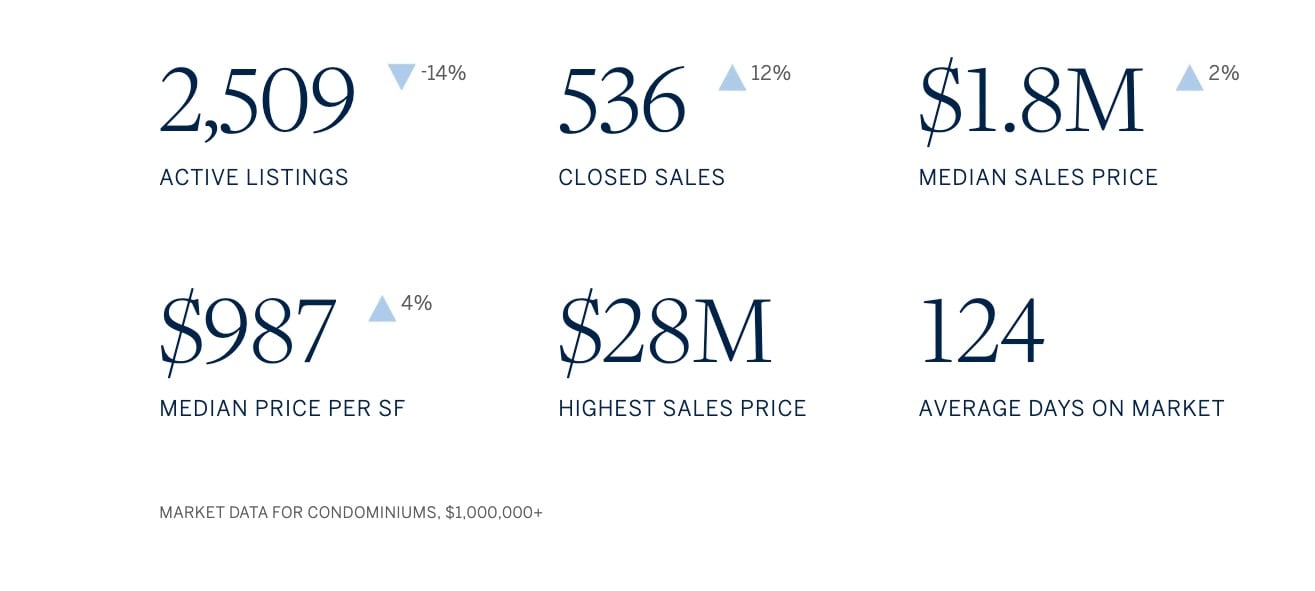
The luxury condominium market also strengthened in Q2, although the pace remained more measured. Miami-Dade recorded 536 condo sales at $1 million and above, up 12% year over year. The median price increased 2% to $1.8 million, while the median price per square foot rose 4% to $987.
Active luxury condo listings declined 14% to 2,509, yet the category still offered more inventory than the single-family market. Condos also averaged 124 days on the market, compared with 93 days for single-family homes.
Monthly activity was uneven. New listings fell from 460 in April to 365 in June. Closed sales totaled 204 in April, 151 in May and 181 in June. The June rebound is encouraging, but the data reinforces how closely buyers are examining each building and residence.
For condo sellers, the competition is not simply the unit next door. Buyers are comparing views, floor plans, renovation quality, monthly fees, reserves, assessments, insurance, amenities and the overall financial health of the association. A residence that is priced without considering those factors can remain available even when the broader sales figures are improving.
The Broader Miami Market Strengthened Through June
The latest June figures provide useful context for the luxury report. Miami-Dade recorded its best June in three years, with total residential sales rising 14.3% year over year to 2,107 transactions. Sales at $1 million and above increased 29.1%, substantially outpacing the market as a whole. Single-family sales rose 16.8%, while existing condo sales increased 12%.
Inventory also moved lower. At the end of June, Miami-Dade had 4,380 active single-family listings, down 22.7% from the prior year, and 11,550 condo listings, down 11.5%. Total residential dollar volume increased 36.4% to $2.4 billion.
Pricing was more nuanced. Across all price ranges, the median single-family sale price reached $695,000, up 3.7% year over year, while the existing condo median declined 3.2% to $431,000. At the luxury level, however, the Q2 report showed median prices increasing for both property types. This contrast is a reminder that a single countywide headline cannot accurately describe every segment of the Miami real estate market.
Cash and International Buyers Continue to Distinguish Miami
Miami's buyer pool remains unlike that of most U.S. markets. Cash represented 38.1% of all Miami-Dade residential sales in June, including 48.5% of existing condo purchases. By comparison, approximately one-quarter of U.S. home sales were cash transactions.
International demand remains another defining part of the market. Foreign buyers purchased $4.4 billion in South Florida residential real estate in 2025, up from $3.1 billion in 2024. Miami-Dade accounted for 73% of those buyers and $3.2 billion in sales volume. Fifty-one percent of international purchases were completed in cash, and 51% of global buyers selected condominiums.
This mix of local, domestic and international demand gives Miami multiple sources of buyer activity. It also helps explain why the luxury and new-development sectors can behave differently from interest-rate-sensitive portions of the resale market.
Condo Financing and Building Health Matter More Than Ever
The Miami condo market cannot be evaluated on price and location alone. Building reserves, milestone inspections, special assessments, insurance and financing eligibility can all affect a buyer's options and a seller's timeline.
Only 21 of 2,397 condominium buildings across Miami-Dade, Broward and Palm Beach counties were FHA approved, according to figures cited by MIAMI REALTORS®. New condo-lending standards effective August 3, 2026, retire Fannie Mae's Limited Review process and Freddie Mac's Streamlined Review process for new loan applications. The practical effect will vary by property and borrower, but the shift makes early lender and association-document review even more important.
For sellers, gathering current association documents before listing can help identify possible financing questions in advance. For buyers, reviewing the building should receive the same level of attention as evaluating the residence itself.
What the Q2 Miami Market Means for Sellers
The Q2 figures are encouraging for sellers, particularly in the luxury single-family market, but strong statistics do not replace a property-specific strategy.
Sellers should:
- Price against the most relevant recent sales and active competition, not a broad county median.
- Complete high-impact cosmetic improvements before photography and launch.
- Use professional visuals and clear positioning to establish value immediately.
- For condos, prepare current financial, reserve, assessment and insurance information as early as possible.
- Reassess quickly if the listing is receiving attention but not producing offers.
With fewer listings entering portions of the luxury market, a home that is introduced correctly can stand out. A property that begins above the market may still lose valuable time.
What the Q2 Miami Market Means for Buyers
Buyers are seeing more choices in the condo sector than in the single-family market, but attractive properties are not necessarily sitting indefinitely.
Buyers should:
- Obtain financing guidance before touring, especially when considering a condominium.
- Compare the complete cost of ownership, including insurance, association fees and potential assessments.
- Review recent sales within the specific neighborhood or building.
- Look beyond list price to condition, view, floor plan, building health and long-term marketability.
- Be prepared to act when a well-priced property meets the right criteria.
The opportunity in the current market comes from being selective and informed, not from assuming every seller will negotiate in the same way.
Miami Real Estate Outlook for the Second Half of 2026
The second half of 2026 begins with higher sales, contracting inventory and continued strength at the $1 million-plus level. Single-family homes appear best positioned where supply is limited, while the condo market offers more room for property-by-property negotiation.
Cash liquidity, international demand and Miami's expanding selection of luxury and branded residences remain important supports. At the same time, buyers are placing greater emphasis on value, building quality and financial transparency.
The result is a market that rewards precision. The strongest outcomes will come from understanding the individual property, its immediate competition and the buyer profile most likely to see its value.
If you are considering buying or selling in Miami, a neighborhood and building-specific analysis will provide far more useful guidance than a countywide average alone. Reach out to Anna Sherrill at 786-853-8484 or [email protected] for a confidential conversation about your goals and the opportunities available in today's market.